Boulder Bike Story from Bikes Belong on Vimeo.
Showing posts with label policy. Show all posts
Showing posts with label policy. Show all posts
Tuesday, September 29, 2009
How a town becomes bike friendly
This video, from Bikes Belong, shows how Boulder, CO became bike friendly (and how Athens could too):
Wednesday, April 15, 2009
Bike commuting & tax benefits
This NYT article discusses the federal stimulus bill's provision offering a monthly tax benefit of $20 for bicycle commuters.
For more information, look at Commuter Check, and definitely talk to your workplace about offering this tax incentive!
I've already written UGA administrators about this. I'll pass along the response I receive.
Accor Services USA, one of the nation’s larger administrators of commuter tax-free benefits, began offering a bicycle commuter check to employers only last month, said Jeremy Doak, a marketing manager with Accor. But interest in the program was high. Mr. Doak estimated that an average of 100 businesses per month since the law was passed had asked about offering the credit to their employees.
So far, the company has set up accounts only with smaller companies, those with fewer than 50 employees. And a majority of those that have actually ordered credits, perhaps not surprisingly, come from the West Coast, primarily from the San Francisco Bay area. Mr. Doak noted that the company had orders from Illinois and Massachusetts as well.
For more information, look at Commuter Check, and definitely talk to your workplace about offering this tax incentive!
I've already written UGA administrators about this. I'll pass along the response I receive.
Friday, March 27, 2009
Trying to find my happy place
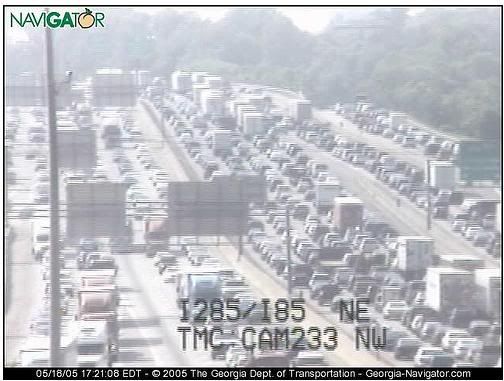
Good thing this was published at the same time as this and this. By the power of Greyskull. Or, as granny n'em used to say, "I ain't seen nuthin' like this in all my born days."
For your enjoyment: a graphic representation of the legislature's approach to solving transportation issues.
For your enjoyment: a graphic representation of the legislature's approach to solving transportation issues.
Tuesday, March 24, 2009
Losing our chance for TSPLOST again?!
The AJC reports:
"Legislators still split on transportation tax"
"Legislators still split on transportation tax"
Prospects for a new sales tax to pay for roads, bridges, rail and other transportation improvements have hit a barrier as the legislative session nears an end.The Senate on Monday passed its version of an optional transportation sales tax — for the second time.
The Senate and House disagree on how to set up a new penny sales tax for transportation.
The Senate supports a regional tax, where groups of counties — including the Atlanta area — could band together to tax themselves for local projects, thus giving more local control over transportation dollars. The House supports a statewide tax because roads do not end at the county line.
The Senate on Monday approved a gutted version of the House transportation measure. The substance of House Resolution 206 had been replaced with the Senate’s original vision for a regional sales tax.
Because the Senate has not budged from its position, the two chambers would have to agree on a compromise in the last five days of the session, or the prospect of a transportation tax would die for now.
Please contact your state representative and senator, and urge them to find a workable compromise on this deal. Georgia cannot wait any longer to tackle its haywire transportation system.
Monday, March 9, 2009
TSPLOST, GDOT legislation
ABH summarizes the current status on a number of legislative items, including TSPLOST:
► Senate Resolution 44
Constitutional amendment to create T-SPLOST, a 1 percent special-purpose, local-option sales tax for transportation
Status: Passed the Senate, in House Transportation Committee
► SB 200
Transfer transportation construction from the state Department of Transportation to the new State Transportation Authority
Status: Passed the Senate, awaiting House committee assignment
► SB 39
Constitutional amendment to allow counties to levy a 1 percent sales tax for transportation for projects of their choice, gutted in the House
Status: Passed Senate and House, in conference committee
► HB 605
House version of a bill to transfer state transportation construction from the Department of Transportation to the new State Transportation Authority
Status: House Transportation Committee
► HB 277
House bill to levy a 1 percent sales tax statewide for specified transportation projects over 10 years
Status: Passed House, Senate Finance Committee
HB= House Bill
SB= Senate Bill
Thursday, January 22, 2009
Good ideas for the stimulus plan
From the Congress for the New Urbanism, via Design New Haven:
According to the CNU, priority stimulus funding should be given to projects that enhance connectivity to the greatest degree, e.g., by reducing block sizes, increasing sidewalk space, and converting one-way streets to two-way streets, and increasing the number of intersections per square mile by eliminating major "gaps" in the network.
"Communities across the country realize their future is in walkable, livable, fuel-efficient neighborhoods — they want to build up the infrastructure that supports that vision. If the pavement portion of this stimulus winds up looking like just another superhighway bill, it will be a step backwards from energy independence and from lasting economic recovery in home and real estate markets, which is where the economic crisis started."
Wednesday, January 21, 2009
Budget woes & transit talk
Also in the current Creative Loafing, an article about the state's overall budget crisis and the debate over transit in Georgia and how to pay for it.
While the whole piece is worth a read, here's the gist :
Get in touch with your elected officials to let them know you support an increase in general support for public transit, sidewalks, and bicycle infrastructure in Georgia, as well as a 1 cent sales tax (aka TSPLOST) dedicated to funding transit & rail.
While the whole piece is worth a read, here's the gist :
Cheers.[Alan Essig, executive director of the Georgia Budget and Policy Institute] says Georgia, which has one of the lowest tax burdens in the nation, is in a “structural deficit.” For the past 10 years, the Gold Dome’s addiction to cutting taxes while doling out incentives to businesses cost the state an estimated $1.5 billion annually.
Contrary to what most GOP power-hitters say, Georgia has a revenue problem, Essig says, not a spending problem, and the decades-old habit of bending over backward in terms of tax credits, incentives and exemptions has left the state no better off.
“The problem is [the budget’s] lacking any bold vision,” Essig says. “The elected leadership has to tell Georgians what it takes to develop first-class health care, first-class education and first-class transportation — and be honest about ways to raise revenues to do it. And if we’re not going to do it, then to stop promising that goal.”
AMID CONCERN OF THE state’s budget woes, there will be other issues that demand lawmakers’ attention — some say immediate attention.
Chief among them: the ever-pressing challenge of the state’s notorious congestion problem.
Last year, a lack of funding to build roads, repair bridges, and introduce much needed public transit to our auto-dependent state was one of the biggest hurdles the General Assembly tried to overcome. Look around and you can see the problem was far from solved.In the run-up to this year’s session, the state’s most powerful business leaders echoed their call for lawmakers to create a new funding source for transportation. The most popular idea — a 1 cent sales tax that counties could levy on themselves to fund road, rail and bridge projects — is a slightly altered version of legislation that failed by three votes in the Senate just minutes before the General Assembly adjourned in 2008.
Judging by Perdue’s recent speech to lawmakers, however, we’ll still be sitting in gridlock come next year. He says he’ll support a new transportation tax when such a plan makes “business sense.” Last week, the governor proposed a sweeping overhaul of the state’s countless transportation agencies, parroting last year’s line that the different groups are in need of reform before they receive more money.
Nonetheless, lawmakers are giving transportation funding another go. Last week, Sen. Jeff Mullis, R-Chickamauga, introduced legislation that would revive the regional sales tax funding mechanism. Members of the House want a statewide 1 cent sales tax, a move that Cagle says isn’t likely to pass in the Senate, over which he presides. If either moneymaking mechanism were to succeed, it would require a state constitutional referendum on the 2010 ballot. In other words, there won’t be any new funds for a while.
Perdue has indicated a willingness to fund public transit, if not MARTA specifically. The Georgia Regional Transit Authority, which Perdue oversees, has been appropriated $11.6 million by the governor for new buses to shuttle commuters from intown to the suburbs. The agency requested the funds last year as well, only to be rebuffed by lawmakers.
In terms of commuter rail, Perdue received a tongue-lashing from U.S. Rep. David Scott, D-Ga., because the governor didn’t include in the budget funding for a rail line between Atlanta and Griffin, a project he said he’d support during the state’s gas shortage last year.
The good news: Lawmakers are lining up to support a bill that would allow alcohol to be sold in stores on Sundays. It won’t solve the deficit — an additional day of booze revenues would only generate $4.8 million in taxes — but it would at least provide more options for drinking away your economic sorrows.
Get in touch with your elected officials to let them know you support an increase in general support for public transit, sidewalks, and bicycle infrastructure in Georgia, as well as a 1 cent sales tax (aka TSPLOST) dedicated to funding transit & rail.
Monday, January 12, 2009
Budget crunches, bailouts, and transit
ABH features a story today discussing Georgia's deepening financial problems. But, with the prospect of both federal bailout money for states and another vote on a TSPLOST bill, we may see significant investment in transportation infrastructure. Hopefully, that means rail lines, buses, and rail-trails.
Excerpt:
Public transportation is also very much a social justice issue, a poverty alleviation strategy, a traffic reduction tactic, and a jobs creation program. It's also a fundamentally more sutainable approach to transportation planning. When gas prices spiked last summer, which they'll likely do again, transit ridership increased dramatically. In the event of another fuel price increase, having a reliable, extensive public transportation network also makes sense for economic security.
Thankfully, our local officials have expressed support for a TSPLOST approach to funding transit and have shared this with the Athens area delegation to the state capitol.
Excerpt:
Why do these media scribes lean so heavily on the word environmentalists?Congestion in cities, the desire for rural highways to help recruit employers and environmentalists' hopes for mass transit all converge in a quest for additional funding for transportation.
Business groups and environmentalists are lobbying for a constitutional amendment that, if approved, would allow groups of counties to levy a regional sales tax to pay for regional transportation projects. A similar proposal passed the House and fell three votes short in the Senate in the final moments of last year's session.
Senators said there wasn't time to work their way through the proposal's complexities, such as assuring that voters in counties that reject the regional tax would not have to pay it.
Lt. Gov. Casey Cagle has said he wants the Senate to pass its version of the bill this week, while House leaders have said there is little reason to rush, since the matter can't be put on the ballot for public ratification until the next general election in 2010.
Public transportation is also very much a social justice issue, a poverty alleviation strategy, a traffic reduction tactic, and a jobs creation program. It's also a fundamentally more sutainable approach to transportation planning. When gas prices spiked last summer, which they'll likely do again, transit ridership increased dramatically. In the event of another fuel price increase, having a reliable, extensive public transportation network also makes sense for economic security.
Thankfully, our local officials have expressed support for a TSPLOST approach to funding transit and have shared this with the Athens area delegation to the state capitol.
Saturday, January 3, 2009
GA lowers gas tax
Happy New Year!
Our first post for 2009 relays the bittersweet news that Georgia's already moderate gas tax has been lowered even further.
Our first post for 2009 relays the bittersweet news that Georgia's already moderate gas tax has been lowered even further.
The state tax was lowered by 4 cents per gallon to 14.6 cents starting Thursday. Georgia's gas tax is adjusted twice a year based on the average price of gas. When that average price dips - as it has in recent months - the tax goes down as well. Gov. Sonny Perdue rescinded an executive order he issued in June that froze the tax as prices skyrocketed during the summer.
The reduction cuts millions of dollars for the state Department of Transportation, which had a $456 million budget deficit for the fiscal year that ended July 31, according to an audit report in September.
"Our costs are going up and our revenues are declining," DOT spokesman David Spear said Friday. "We're trying to prioritize our projects and do the things that are most needed."
The DOT budget for this year is about $2.3 billion, with about half coming from federal gas tax revenues and a comparable amount from the state. Spending could be padded by a "few hundred million" dollars in bond sales, Spear said.Transportation funding is a problem nationwide. With motorists driving less and buying less fuel, the current 18.4-cents-a-gallon gas tax and 24.4-cents-a-gallon diesel tax fail to raise enough to keep pace with the cost of road, bridge and transit programs.
In Georgia, a proposal to allow counties to group together and impose a regional sales tax to pay for transportation projects failed to pass in last year's General Assembly by one vote. The legislature is expected to try to tackle a statewide transportation plan in the session beginning this month.
Let's hope the legislature & GDOT concentrate on projects that are "most needed," such as commuter rail, transit expansion, and transportation-oriented bicycle and pedestrian infrastructure. Recklessly throwing money at road widenings and interstate construction will only waste GDOT's time and money and will exacerbate our state's transportation crisis.
Wednesday, December 17, 2008
GDOT projects list
Last week, I wrote GDOT and asked them what "ready to go" projects they were submitting should the national infrastructure bailout funds come through.
Below is their response:

Below is their response:
Thank you for contacting YOUR Georgia Department of Transportation.It's good to see that MARTA is receiving the help it needs, but road projects take up nearly 2/3 of this $3+ billion list. Commuter rail and transit are barely recognized, when what we need is a massive infusion of investment in these modes of transportation. We do not need to continue feeding the growth of a failed transportation model.
The Georgia Department of Transportation looked at all of the projects that we had out there. We took a thorough look at safety, bridges, intersections, new capacity and maintenance. The biggest driving force in identifying the projects for our list was the 180 day criteria. We identified projects that we considered were ready to go meaning that; environmental approval from FHWA, Right of Way acquisition, designs and plans all would be complete and the project ready to let within 180 days. We had a number of projects that could meet that standard- totaling some $3 billion which we submitted. This is merely a preliminary list and we are still reviewing projects and looking at other considerations before a final decision is made. The Board will also have an active role in our project identification process and intends to solicit input from local governments and our transportation partners as we continue to further develop our list.
December 8, 2008
SUMMARY
Aviation $45,344,231 (1.3%)
MARTA
$1,100,830,000 (32%)
Transit
$61,978,000 (1.8 %)
GRTA (GA Regional Transportation Authority)
$8,000,000 (0.2%)
GDOT Roadway Projects (Including Maint.)
$2,205,308,473 (64%)
Commuter Rail
$22,575,000 (0.6%)
Grand Total
$3,444,035,704
Again, we thank you for submitting your inquiry to the Georgia DOT. Please continue to contact us with your comments and questions.
Thanks,
Office of Constituency Services
Georgia DOT
Monday, December 15, 2008
A good outline for that letter you're going to send to Congress
via Streetsblog:
To find out who your elected officials are, visit Congress.org.
Here's a template op-ed on the Transportation for America coalition's concerns about the shaping of the stimulus bill. This is a VERY critical moment in the debate. We think Congress should:
Conduct the discussions about what gets funded in the open: All states should make public what they are proposing. They should get no blank checks, but should be accountable toward national priorities. Those national priorities should include longterm benefits to the economy, safety, reduced oil dependence and carbon emissions. We should fix what we have before we build new highways.
Obama, Congress Must Back Up Rhetoric on Recovery
Last week President-elect Barack Obama made a promise to the American people and issued a charge to his incoming Administration and the next Congress:
"We won't just throw money at the problem. We'll measure progress by the reforms we make and the results we achieve – by the jobs we create, by the energy we save, by whether America is more competitive in the world." Dec. 6 Radio Address
As to how to achieve this progress, the President-elect proposed to “create millions of jobs by making the single largest new investment in our national infrastructure since the creation of the federal highway system in the 1950s.”
While the new President is clearly eager to chart a bold and new course to rebuild our economy from day one — and the new Democratic-controlled Congress should be poised to follow his lead — rhetoric alone will not be enough.
Members of Congress are already hard at work writing the stimulus package, reviewing transportation projects and infrastructure requests from states. Disturbingly, though, this is being done behind closed doors, and only a handful of states have made their wish lists public. Those that have are less than encouraging, focusing overwhelmingly on repaving, or worse, expanding highways in an era when people are driving less and transit is seeing surging demand.
Missouri DOT’s wish list, one of the few made public, includes an eye-popping $800 million worth of projects, 95 percent highway projects. This has next to nothing for St. Louis or Kansas City, population centers that surely need more than just highways. Arizona DOT’s list isn’t much better, with less than ten percent of money going to public transportation.
Congress is proposing to distribute stimulus money for infrastructure projects without requiring the usual local match, meaning that federal taxpayers will pick up the full tab. Given that reality, Congress must require transportation agencies to select projects that meet national goals for the future, rather than merely build yesterday’s highway projects.
If American tax dollars are spent the right way, we should get a three-for-one-return on our investment: a revitalized economy well positioned for long-term prosperity; less dependence on oil; and a reduction in climate-damaging emissions.
This is possible if the economic stimulus package the President-elect is expected to sign on day one includes a $100 billion investment to:
· Repair and preserve highways, bridges and existing public transportation service, and support the green jobs associated with this work;
· Build modern rail and rapid bus lines and upgrade all forms of service in cities large and small;
· Develop high-speed and other forms of inter-city rail; and
· Make streets safe for walking and biking.
Such investment will not only move America closer to fulfilling Obama’s vision for a bold, green recovery that will create jobs, reduce our oil consumption, and help America compete and thrive. It also will provide a down payment on a 21st Century transportation mission to build the second half of America’s transportation network, completing the system that began with the national highway system.
While repairing existing roads and bridges is a necessary expenditure, given that the national highway system has been built, federal resources and attention must go toward supporting the cleanest forms of transportation — public transit, high speed rail, walking and biking. The Transportation for America Campaign has identified more than 65 such ready-to-go projects within the next year, requiring over $17B in funding to get going.
Given that the stimulus is meant to fund only ready-to-go projects, states, transit agencies and metropolitan areas should quickly turn around a specific list of which projects will be funded, in an accessible and transparent manner. Tracking systems should also be instituted to provide the public with indicators on the number of jobs created, cost-effectiveness, carbon emissions, fuel use and demand forecasting.
U.S. Senator Harry Reid said earlier this month that the stimulus can allow us to “abandon the baby steps and embrace some great leaps forward” on energy, and House Speaker Nancy Pelosi added that the recovery is “about innovation and about the future, about building the jobs of the 21st century.”
That change is possible, but only if we put action behind rhetoric. And if we fail, Americans will not see the change the next Congress and Administration were elected on; rather, they will see more of the same.
David Goldberg
Communications Director
Transportation for America
office/mobile (202) 412-7930
www.T4America.org
To find out who your elected officials are, visit Congress.org.
Wednesday, November 5, 2008
How to emulate Portland
This week, Flagpole columnist Kevan Williams describes a number of ways Athens could follow the lead of Portland, OR in improving pedestrian and bicycle infrastructure. New Commission, take note!
For the rest of us, let's make a concerted effort to tell MACORTS about our desire for this kind of sustainable transportation equality.
Excerpts:
Full article here.
For the rest of us, let's make a concerted effort to tell MACORTS about our desire for this kind of sustainable transportation equality.
Excerpts:
In Portland, drivers stop at crosswalks, even without flashing lights and neon bollards. ... It would take a lot of enforcement to ingrain that pedestrians always have the right-of-way here in the South, but the payoff is worth it: it slows everyone down, and puts drivers in a situation where they ought to be looking for pedestrians, instead of driving through and idling in crosswalks while trying to turn.
Certain routes within Portland are designated as bike routes, regardless of the infrastructure in place. Even if there are no bike lanes or “sharrows,” a flat side street could be made an official bike route. Imagine if BikeAthens’ bike map were adopted by the city, and those routes which were good for bicycling were then signed by the city to guide bicyclists.
In Portland, what we would call greenway trails are considered an important transportation network, just like rail and roads. There is a comprehensive system of off-street bicycle trails, in some cases extending miles without crossing a street. These don’t just follow the rivers, but also rail lines, transmission lines, highways and other easements where access is already limited. Most importantly, these routes actually go places, and are fed by on-street bicycle routes in a logical manner.
Bringing It Home: Portland is a city that’s a lot like Athens; it’s not a metropolis of especially tall buildings, and its greatest strength lies in its walkable neighborhoods. Basic services in Portland can be reached by bicycle on a neighborhood scale just as easily as can thousands of workplaces downtown on a citywide scale. The neat thing is that most of it isn’t done through huge infrastructure and park projects; there seems to be a commitment to a bottom-up approach, which focuses on making neighborhoods and side streets safe to walk first, and then builds up into an entire city of cyclists. After all, if people don’t feel safe crossing the street at the end of their block, they won’t be biking across town on a greenway.
Full article here.
Thursday, September 18, 2008
not quite rock bottom
The League of American Bicyclists, a national bike advocacy group, has published their ranking of states, based on their commitment to supporting cycling as a safe & effective form of transportation and recreation.
Way to be, Georgia! We're not the absolute worst! Good grief.
While this ranking is probably accurate for the state overall, our happy town is making some decent headway toward being friendlier and safer for all modes of transportation, including bicycles.
Obviously, plenty of work remains to be done!
The League of American Bicyclists has announced our first annual ranking of Bicycle Friendly States, scoring all 50 states on more than 70 factors. The states were scored on responses to a questionnaire evaluating their commitment to bicycling and covering 6 key areas: legislation; policies and programs; infrastructure; education and encouragement; evaluation and planning; and enforcement. The highest and lowest scoring states overall were:
Top 5
1. Washington
2. Wisconsin
3. Arizona
4. Oregon
5. MinnesotaBottom 5
46. North Dakota
47. Mississippi
48. Alabama
49. Georgia
50. West Virginia
Way to be, Georgia! We're not the absolute worst! Good grief.
While this ranking is probably accurate for the state overall, our happy town is making some decent headway toward being friendlier and safer for all modes of transportation, including bicycles.
Obviously, plenty of work remains to be done!
Monday, September 1, 2008
California sets an example
Good news from the west coast: pending legislative efforts to curb sprawl and greenhouse gas emissions.
From the NYT:
From the NYT:
OK, Sonny. You said you were committed to fixing GA's traffic congestion crisis. Are we gonna have more of the same, or are we gonna get on board with real solutions?SAN FRANCISCO — California, known for its far-ranging suburbs and jam-packed traffic, is close to adopting a law intended to slow the increase in emissions of heat-trapping gases by encouraging housing close to job sites, rail lines and bus stops to shorten the time people spend in their cars.
The measure, which the State Assembly passed on Monday and awaits final approval by the Senate, would be the nation’s most comprehensive effort to reduce sprawl. It would loosely tie tens of billions of dollars in state and federal transportation subsidies to cities’ and counties’ compliance with efforts to slow the inexorable increase in driving. The goal is to encourage housing near current development and to reduce commutes to work.
Thursday, June 19, 2008
Perdue supporting light rail..?!
Very surprising, and exciting, news from the AJC's Business Insider blog:
Shocking tales of delayed recognition!
I hope this turnaround is sincere and will translate into the rapid development of light rail in our state, with a line from Athens to Atlanta (the "Brain Train") high on the list of projects to finish first. We've already made significant progress to be ready for this. The Multi-Modal Center was sited with a commuter rail line in mind.
Keep your fingers crossed and the pressure on!
Here's information on our state representative and senator to help with that pressure bit.
After six years of inaction on transit, Gov. Sonny Perdue surprised the state when he pledged his full support for a pilot commuter rail line from Atlanta to Lovejoy and Griffin, as well as for a substantial increase in the state’s X-Press bus program.
So what happened? Why did the governor do a complete 180 and decide to take a leadership role on an issue that has been driving some people crazy?
That issue is traffic. That issue is a lack of state funding for transit. That issue is the limited options people have to get around in our region and state other than in a car.
Those are not new issues. Leaders in metro Atlanta have been pushing for transportation solutions, including commuter rail, for decades.
Until now, no amount of begging or pleading seemed to get Gov. Perdue’s attention, much less his leadership.
Yet, last Thursday, there was the governor holding a news conference with all the transportation players in his office, speaking words that regional and state leaders have wanted to hear throughout his administration.
“Let’s move out aggressively,” Perdue said. “Once I’ve made up my mind, I’m usually impatient.”
...
There are stories of key events that helped change the mindset of the governor and other state leaders.
In January, GDOT board members and other state transportation folks took a trip to Chicago, Boston and New York to see commuter rail in action.
On that trip, [DOT board member] Kulke told fellow board member Robert Brown: “We are 100 years behind.”
Ye gods!
Shocking tales of delayed recognition!
I hope this turnaround is sincere and will translate into the rapid development of light rail in our state, with a line from Athens to Atlanta (the "Brain Train") high on the list of projects to finish first. We've already made significant progress to be ready for this. The Multi-Modal Center was sited with a commuter rail line in mind.
Keep your fingers crossed and the pressure on!
Here's information on our state representative and senator to help with that pressure bit.
Saturday, April 5, 2008
State Senate's warped priorities let us down
After all the encouraging build up toward finally passing the desperately needed T-SPLOST bill, the Georgia Senate let it slip through our fingers.
According to the Banner-Herald,
On the bright side, the Legislature did ensure our continuing safety in the menacing, kill-or-be-killed world of bus riding in Athens-Clarke County:
According to the Banner-Herald,
State lawmakers worked for months to cobble together a plan to allow local governments to levy a 1-cent sales tax for transportation projects to ease the state's congested roads. It passed in the House but fell three votes short of the needed two-thirds majority in the Senate.It's not saying much, but at least it was close. This legislation should have happened ten years ago. We will just have to re-double our efforts for next year.
On the bright side, the Legislature did ensure our continuing safety in the menacing, kill-or-be-killed world of bus riding in Athens-Clarke County:
Lawmakers [did vote] to allow Georgians with concealed weapons permits [to] carry their guns on public transportation.We're so glad they're looking out for our best interests.
Thursday, April 3, 2008
"Peak Oil"? What's that?
A story from the Columbia Journalism Review investigates why you might not have heard of peak oil:
Oil has always been a big story for obvious economic, environmental, political, and technological reasons. For decades, Americans have read about tanker spills, rising oil prices, shortages at the pumps, and delicate trade relations. More recently, the press has swarmed the story of prices topping $100 a barrel and OPEC’s refusal of President Bush’s request to increase production. But throughout the history of oil reporting, there has been one major aspect that the press has remained largely silent on: peak oil.
Wednesday, February 13, 2008
An amazing initiative in London
This news is the stuff of alt-trans advocates' dreams, especially here in the South.
Excerpt:
Excerpt:
The Mayor of London today announced the most ambitious programme to transform walking and cycling in London’s history. The package of measures will create a new network of quick, simple, and safe routes for cyclists and pedestrians that will change the profile and priority of walking and cycling on London's streets.The Mayor of London, Ken Livingstone, said:
"The aim of this programme is nothing short of a cycling and walking transformation in London. We will spend something like £500 million over the next decade on cycling - the biggest investment in cycling in London's history, which will mean that thousands more Londoners can cycle in confidence, on routes that take them quickly and safely to where they want to go."
Wow. Dare to dream, Athens. Dare to dream...


Saturday, February 9, 2008
People-Powered Coalitions
Some encouraging news from California:
The coalition opposing the freeway was impressive in its size and scope. It included environmental groups from across California, and city governments from the San Diego coast.
...
People-powered coalitions don't just exist in elections - they're all over our state, and the victory over the 241 toll road is a major victory for just that kind of organizing power.
...
No longer can we look to new roads to solve our transportation problems. For environmental, sustainable, climate, and even fiscal reasons, mass transit, particularly rail, is where we need to be investing for our future - not a toll road that will struggle to stay financially viable and see steadily decreasing traffic as peak oil sets in.
Friday, February 1, 2008
"Global warming real"
From a story in today's ABH:
Devastating forest fires. Atlanta as hot as Houston. Permanent drought.and
Those are a few of the effects of global warming Georgians will feel if the United States doesn't act fast to slow down the carbon emissions that heat up the globe's climate, University of Georgia ecologist James Porter said Thursday.
"These things are coming. These things are coming fast," said Porter, one of the key speakers at the Athens session of Focus the Nation, a nationwide teach-in on global warming held at UGA and about 1,000 other U.S. colleges and schools Thursday. "This is physics. This is not politics."
Just practicing energy conservation would cut U.S. energy consumption by 25 percent, he said. Fuel-efficient cars, more public transportation, full recycling, family planning to curtail population growth and more energy-efficient food production also are important, he said.I would add that development and zoning practices that encourage density are equally important. Walk-able, bike-able communities, dotted with parks, are not only more pleasant, but certainly more sane, considering the climactic prognosis. Plus, this type of dense development is far more amenable to effective public transit.
Subscribe to:
Posts (Atom)


 Posts
Posts


