From Grist :
10 ways cities and towns can kick the offshore-oil habit
No suprises here - these solutions have been known for quite a while. Build densely and in ways that fully accomodate a wide range of transportation choices. In other words, build places that are walkable, bikeable, and transit oriented.
When we create places that can only be accessed and traversed by private automobile, surprise! - we become desperately car (and thus oil)-dependent.
Demand a more livable future, not only for your own neighborhood, but for the thousands of people, and other creatures, that your daily decisions and errands impact.
Showing posts with label development. Show all posts
Showing posts with label development. Show all posts
Friday, June 11, 2010


Monday, May 24, 2010
Fixing southern sprawl
This video is part of an award-winning, six-part series called American Makeover and features many of the local thinkers, developers, and researchers who participated in this month’s Congress for New Urbanism’s conference in Atlanta. One of the participants was David Byrne, who was interviewed by Creative Loafing about bicycles, cities, and Atlanta.
Saturday, March 20, 2010
Lost city of Atlanta?
Here's a thought provoking preview of what may be the end game to the sprawl-dependent economic model so prevalent in the southeast:
Detroit, the very symbol of American industrial might for most of the 20th century, is drawing up a radical renewal plan that calls for turning large swaths of this now-blighted, rusted-out city back into the fields and farmland that existed before the automobile.
Operating on a scale never before attempted in this country, the city would demolish houses in some of the most desolate sections of Detroit and move residents into stronger neighborhoods. Roughly a quarter of the 139-square-mile city could go from urban to semi-rural.
Tuesday, February 16, 2010
Rails-with-trails
Flagpole's Athens Rising column explores informal uses of urban space and how "the way people use the city doesn’t necessarily correspond with the planning and design intentions of the government."
When families and otherwise “adult” people join the exploring kids as benign trespassers, this may be a symptom of some larger issue in the built environment. Rather than working to eliminate these symptoms, we ought to understand their underlying causes. The guerrilla SPOA (Skate Park of Athens) illustrated a need, which ultimately resulted in a sanctioned skate park being built at the Southeast Clarke Park. The High Line, in New York, is another example of informal park uses taking on a formal status.
...
The spaces that people choose to occupy with these informal uses are ones that have been disregarded or left undefined in some way.
...Consider the folks who walk along the railroad tracks. The rail right-of-way provides a useable route between destinations. People who walk along the tracks are interested in the route, and not the rails themselves. Building a formal walking path with a fence between it and the tracks gives people a safer alternative than walking on the rails in the same way that a sidewalk along a road is safer than people walking on the shoulder. This logic has been implemented in many communities around the country, leading to the creation of “rails-with-trails” (the logical outgrowth of the rails-to-trails movement).
That sort of logic should be applied to address the alternative ways people use the city in every case. People do things for reasons, and by understanding the causes of actions, we can build a city which is more interesting and more equitably accessible.
Wednesday, November 18, 2009
Reed Alley update
The state Board of Regents won't approve this renovation proposal until next spring.
Wednesday, November 4, 2009
Downtown deck approved
A 520-space, mixed-use, downtown parking deck got the go-ahead from the ACC Mayor & Commission. This deck will be built in the lot behind and adjacent to the Georgia Theatre.
ABH provides this artist's rendering of the deck design:

ABH provides this artist's rendering of the deck design:

Tuesday, April 14, 2009
UGA-ACC land deal opens door for greenway expansion
From the Banner-Herald:
The University System Board of Regents today should approve the University of Georgia's decision to donate 1.35 acres of land off East Campus Road to the Athens-Clarke County government.
[R]iverside acreage [will] extend the North Oconee River Greenway from Oconee Hill Cemetery all the way south to College Station Road.
Athens-Clarke will get land along the North Oconee River to extend the North Oconee River Greenway from Oconee Hill Cemetery to College Station Road. The planned bridge will allow cyclists on the greenway to get to bike lanes on College Station Road.
Thursday, March 26, 2009
Public Hearing: Jefferson Rd Publix development
What: Public hearing regarding proposed development of a mixed-use shopping center, anchored by a Publix grocery store, to be located on Jefferson Road between Trinity Place and Moss Side. Map of proposal below (click to enlarge)
Where: Christian Life Worship Center, corner of Kathwood and Old Jefferson Road
When: Monday, March 30th, 6:30 pm

Where: Christian Life Worship Center, corner of Kathwood and Old Jefferson Road
When: Monday, March 30th, 6:30 pm

Wednesday, March 25, 2009
Friday, March 6, 2009
Downtown parking deck
"The Athens-Clarke Commission is on track to pick a developer to work with on a $20 million downtown Athens parking deck, " reports the Banner-Herald.
Atlanta-based Batson-Cook Development is the frontrunner to design, build and fund part of a long-planned mixed-use parking deck in a surface lot near the Georgia Theatre.
The public-private partnership would be a first for Athens, although they're common in other cities, such as Greenville, S.C., and Savannah.
The preliminary plan consists of a six-story structure that looks like a building, not a parking deck. It includes 520 parking spaces, 12,000 square feet of ground-level retail space along West Clayton and Washington streets, 23,000 square feet of high-end office space on the top floor and a rooftop garden.
ABH provides this artist rendering of the deck as well:

Could any of the parking go below street level?
Bike racks and/or lockers, scooter parking, and an Athens Transit bus stop would be nice as well.
The roof-top garden and mixed-use aspects sound very cool, and it's a relief that the architects are trying to avoid the grim aesthetics of a parking deck.
Thursday, January 22, 2009
Good ideas for the stimulus plan
From the Congress for the New Urbanism, via Design New Haven:
According to the CNU, priority stimulus funding should be given to projects that enhance connectivity to the greatest degree, e.g., by reducing block sizes, increasing sidewalk space, and converting one-way streets to two-way streets, and increasing the number of intersections per square mile by eliminating major "gaps" in the network.
"Communities across the country realize their future is in walkable, livable, fuel-efficient neighborhoods — they want to build up the infrastructure that supports that vision. If the pavement portion of this stimulus winds up looking like just another superhighway bill, it will be a step backwards from energy independence and from lasting economic recovery in home and real estate markets, which is where the economic crisis started."
Friday, July 11, 2008
Athens reels 'em in
According to new population estimates out of the U.S. Census Bureau, Athens "is the second fastest-growing city of more than 75,000 in the state," adding nearly 12,500 residents to the incorporated metro area since 2000.
With more people coming to enjoy Athens' many amenities, and oil definitively on its way out as our means for powering society, we ought to carefully consider and manage our future growth and transportation infrastructure. We need transportation choices, networking a localized economy that does not rely on the whims & chance of increasingly volatile energy markets.
The growth in Athens and Atlanta reflects a national trend, said Jeff Dufresne, executive director of Atlanta's Urban Land Institute. Atlanta and many other central cities lost population from the 1960s up to the 1990s, but now people are moving back to avoid traffic hassles, and to be closer to jobs and urban amenities, he said.
But "Athens has done a lot of good things in the last 25 years," Dufresne said, citing bike paths and National Trust for Historic Preservation revitalization programs.
Watkinsville, too, has seen some astronomical growth in this same period:
Full story from the ABH here.Though Athens' growth is impressive compared to other large Georgia cities, the city's population increase pales in comparison to growth in many smaller towns in Northeast Georgia.
In fast-growing Jackson County, Braselton (which also straddles Hall, Barrow and Gwinnett counties) more than doubled and Watkinsville grew by nearly 35 percent, according to the estimates.
[Watkinsville Mayor Jim] Luken said two major factors driving the town's growth are the Oconee County school system and quality of life.
"You can walk to downtown like they did 100 years ago" from many parts of town, Luken said.
With more people coming to enjoy Athens' many amenities, and oil definitively on its way out as our means for powering society, we ought to carefully consider and manage our future growth and transportation infrastructure. We need transportation choices, networking a localized economy that does not rely on the whims & chance of increasingly volatile energy markets.
Thursday, July 10, 2008
Suffering suburbs
This article from the US Daily describes the nationwide trend pushing people away from car-based suburbia and toward walkable, bike-friendly, and transit-oriented developments.
Excerpts:
Excerpts:
The iconic white picket fence [of suburbia] comes with a hefty price tag in the form of the cost of the gasoline needed to drive to work and to the supermarket, and the suburban idyll is under review.
...Tracy McKelvey and his wife Jan lived in a ... suburb and used to commute two hours each day to their jobs in Phoenix. But, a few years ago, they traded in their three-bedroom, two-garage house in the Phoenix valley for a downtown loft.
Both McKelveys now travel to work by scooter and enjoy restaurants, cafes, sports arenas and shops within walking distance of home, taking advantage of the $2.3 billion that the country's fifth-largest city is spending to build housing, a university campus and a mass transit rail system.
"We save money on gas. It's a good feeling. I haven't sat in a traffic jam for years," Tracy McKelvey said.
...
"These are not the cyclical changes that recessions cause every few years. These are game-changing structural changes," [University of Michigan real estate development professor Christopher] Leinberger said. "The market is demanding walkable urban product."
Thursday, July 3, 2008
The dinosaur days
Part II in a long Telegraph series on America & China discusses Detroit, cars, suburbia, and these "dinosaur days" of all three.
Excerpts:
Excerpts:
Full story here.Mass production...soon moved from [Detroit] to all places of American industry 'and set the pattern of abundance for 20th-century living'.
It is a wonderfully evocative phrase that stops you in your tracks - the pattern of abundance for 20th-century living. From here came the principles of mass production that provided the goods that fuelled the consumer society; from here, the automobile that begat the roads and the freeways that carried people and goods from sea - as America the Beautiful has it - to shining sea, and then to the world beyond.
...Driving around Detroit one was forcefully struck by how the city had been irrevocably shaped - and continued to be shaped - by the car.
Detroit has the second largest amount of freeway lane miles of any metropolitan area in America, after Kansas City. And it is the only city in America without a rapid transport system - the legacy of years of resistance by the powerful lobby of the car industry that dictated that workers should drive their own products rather than taking public transport.
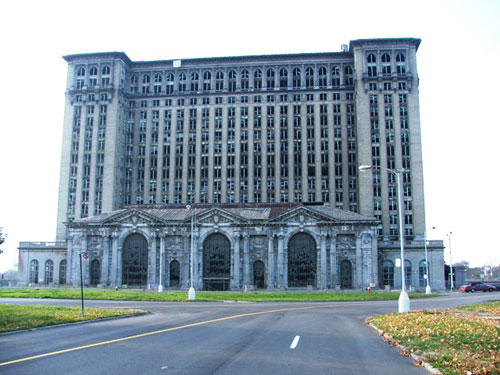
One of the city's most astonishing architectural relics is the Michigan Central Station, a towering, beaux-arts structure built in 1913. The last train pulled out in 1988. But like many of Detroit's great ruins it had proved too expensive to renovate, too expensive to demolish, and so had been left to stand, an enduring testament to the city's decline, and a reproof to its plans for regeneration.
...
Ford's greatest legacy was the car and all that grew from it. As Christopher Leinberger, a professor of urban planning at the University of Michigan, points out, the nature of the American dream has always been driven by the underlying economy of the age. In 1800, at the time of the first census, more than 90 per cent of Americans were engaged in agriculture. 'The American dream at that point could be summarised by the Civil War expression "40 acres and a mule". In the post-war era, one-third of the American economy was related directly, or indirectly, to the building of automobiles - steel, cars, roads, petroleum, insurance. There was an expression that GM used "See the USA in your Chevrolet" - so as you travelled the roads of America in your car you were making yourself and the country wealthier'.
The car become synonymous with America's most cherished ideal - freedom: the freedom to go, to move, to be wherever you chose.
Thursday, November 29, 2007
Mixed use development near Navy School proposed
Full story from ABH here.
Mixed-use developments can help curtail sprawl by creating higher-density communities that reduce the need for people to use their cars, said David Matheny, the architect who produced the conceptual drawings for Moorman's project.
Subscribe to:
Posts (Atom)


 Posts
Posts