Showing posts with label bailout. Show all posts
Showing posts with label bailout. Show all posts
Thursday, April 16, 2009


Thursday, January 22, 2009
Good ideas for the stimulus plan
From the Congress for the New Urbanism, via Design New Haven:
According to the CNU, priority stimulus funding should be given to projects that enhance connectivity to the greatest degree, e.g., by reducing block sizes, increasing sidewalk space, and converting one-way streets to two-way streets, and increasing the number of intersections per square mile by eliminating major "gaps" in the network.
"Communities across the country realize their future is in walkable, livable, fuel-efficient neighborhoods — they want to build up the infrastructure that supports that vision. If the pavement portion of this stimulus winds up looking like just another superhighway bill, it will be a step backwards from energy independence and from lasting economic recovery in home and real estate markets, which is where the economic crisis started."
Wednesday, January 21, 2009
Budget woes & transit talk
Also in the current Creative Loafing, an article about the state's overall budget crisis and the debate over transit in Georgia and how to pay for it.
While the whole piece is worth a read, here's the gist :
Get in touch with your elected officials to let them know you support an increase in general support for public transit, sidewalks, and bicycle infrastructure in Georgia, as well as a 1 cent sales tax (aka TSPLOST) dedicated to funding transit & rail.
While the whole piece is worth a read, here's the gist :
Cheers.[Alan Essig, executive director of the Georgia Budget and Policy Institute] says Georgia, which has one of the lowest tax burdens in the nation, is in a “structural deficit.” For the past 10 years, the Gold Dome’s addiction to cutting taxes while doling out incentives to businesses cost the state an estimated $1.5 billion annually.
Contrary to what most GOP power-hitters say, Georgia has a revenue problem, Essig says, not a spending problem, and the decades-old habit of bending over backward in terms of tax credits, incentives and exemptions has left the state no better off.
“The problem is [the budget’s] lacking any bold vision,” Essig says. “The elected leadership has to tell Georgians what it takes to develop first-class health care, first-class education and first-class transportation — and be honest about ways to raise revenues to do it. And if we’re not going to do it, then to stop promising that goal.”
AMID CONCERN OF THE state’s budget woes, there will be other issues that demand lawmakers’ attention — some say immediate attention.
Chief among them: the ever-pressing challenge of the state’s notorious congestion problem.
Last year, a lack of funding to build roads, repair bridges, and introduce much needed public transit to our auto-dependent state was one of the biggest hurdles the General Assembly tried to overcome. Look around and you can see the problem was far from solved.In the run-up to this year’s session, the state’s most powerful business leaders echoed their call for lawmakers to create a new funding source for transportation. The most popular idea — a 1 cent sales tax that counties could levy on themselves to fund road, rail and bridge projects — is a slightly altered version of legislation that failed by three votes in the Senate just minutes before the General Assembly adjourned in 2008.
Judging by Perdue’s recent speech to lawmakers, however, we’ll still be sitting in gridlock come next year. He says he’ll support a new transportation tax when such a plan makes “business sense.” Last week, the governor proposed a sweeping overhaul of the state’s countless transportation agencies, parroting last year’s line that the different groups are in need of reform before they receive more money.
Nonetheless, lawmakers are giving transportation funding another go. Last week, Sen. Jeff Mullis, R-Chickamauga, introduced legislation that would revive the regional sales tax funding mechanism. Members of the House want a statewide 1 cent sales tax, a move that Cagle says isn’t likely to pass in the Senate, over which he presides. If either moneymaking mechanism were to succeed, it would require a state constitutional referendum on the 2010 ballot. In other words, there won’t be any new funds for a while.
Perdue has indicated a willingness to fund public transit, if not MARTA specifically. The Georgia Regional Transit Authority, which Perdue oversees, has been appropriated $11.6 million by the governor for new buses to shuttle commuters from intown to the suburbs. The agency requested the funds last year as well, only to be rebuffed by lawmakers.
In terms of commuter rail, Perdue received a tongue-lashing from U.S. Rep. David Scott, D-Ga., because the governor didn’t include in the budget funding for a rail line between Atlanta and Griffin, a project he said he’d support during the state’s gas shortage last year.
The good news: Lawmakers are lining up to support a bill that would allow alcohol to be sold in stores on Sundays. It won’t solve the deficit — an additional day of booze revenues would only generate $4.8 million in taxes — but it would at least provide more options for drinking away your economic sorrows.
Get in touch with your elected officials to let them know you support an increase in general support for public transit, sidewalks, and bicycle infrastructure in Georgia, as well as a 1 cent sales tax (aka TSPLOST) dedicated to funding transit & rail.
Friday, January 16, 2009
Op-Ed argues for increased transit funding
“Recovering Stronger,” San Francisco Chronicle:
“Though the list of possible projects released this week by House leadership offered some reason for hope, it still may not go nearly far enough to truly address the challenges of low-income Americans. Instead, one of the biggest federal spending packages the nation has ever seen will largely be used to build more highways to the exurbs - missing an historic moment to make a nation that is more competitive, more inclusive and more rich with opportunity.
Thursday, January 15, 2009
Comment on infrastructure bailout bill
Commentary on the developing story of the federal bailout bill from the blog of Hugh Bartling, a professor in DePaul’s Public Policy Studies program:
Congressional Democrats have just released some detailed numbers that will form the basis of economic stimulus legislation that Obama wants to sign into law by mid-February.
The devil, of course, is in the details. It appears that the $64 billion figure for “shovel ready” projects comes from the American Association of State Highway and Transportation Officials. I am not familiar with their study, but some of the statements coming from AASHTO officials suggest that highway expansion and new roads are heavily weighted in this figure. As Transportation for America implies, maintenance money for bridges and highways should be prioritized over new road and highway construction. Using the stimulus package to exacerbate sprawl will simply cause further air quality and carbon emissions further down the line.
Monday, January 12, 2009
Budget crunches, bailouts, and transit
ABH features a story today discussing Georgia's deepening financial problems. But, with the prospect of both federal bailout money for states and another vote on a TSPLOST bill, we may see significant investment in transportation infrastructure. Hopefully, that means rail lines, buses, and rail-trails.
Excerpt:
Public transportation is also very much a social justice issue, a poverty alleviation strategy, a traffic reduction tactic, and a jobs creation program. It's also a fundamentally more sutainable approach to transportation planning. When gas prices spiked last summer, which they'll likely do again, transit ridership increased dramatically. In the event of another fuel price increase, having a reliable, extensive public transportation network also makes sense for economic security.
Thankfully, our local officials have expressed support for a TSPLOST approach to funding transit and have shared this with the Athens area delegation to the state capitol.
Excerpt:
Why do these media scribes lean so heavily on the word environmentalists?Congestion in cities, the desire for rural highways to help recruit employers and environmentalists' hopes for mass transit all converge in a quest for additional funding for transportation.
Business groups and environmentalists are lobbying for a constitutional amendment that, if approved, would allow groups of counties to levy a regional sales tax to pay for regional transportation projects. A similar proposal passed the House and fell three votes short in the Senate in the final moments of last year's session.
Senators said there wasn't time to work their way through the proposal's complexities, such as assuring that voters in counties that reject the regional tax would not have to pay it.
Lt. Gov. Casey Cagle has said he wants the Senate to pass its version of the bill this week, while House leaders have said there is little reason to rush, since the matter can't be put on the ballot for public ratification until the next general election in 2010.
Public transportation is also very much a social justice issue, a poverty alleviation strategy, a traffic reduction tactic, and a jobs creation program. It's also a fundamentally more sutainable approach to transportation planning. When gas prices spiked last summer, which they'll likely do again, transit ridership increased dramatically. In the event of another fuel price increase, having a reliable, extensive public transportation network also makes sense for economic security.
Thankfully, our local officials have expressed support for a TSPLOST approach to funding transit and have shared this with the Athens area delegation to the state capitol.
Monday, December 22, 2008
Response from the Gov's office
I received a reply to my "open letter," which was sent to Gov. Perdue, state reps & senators, and GDOT:
Thank you for taking time to share your thoughts about ways to improve Georgia's transportation system. I welcome your input in this process.
As you well know, we have much to do as a state to meet our growth-related challenges of air quality and traffic congestion. Higher gas prices have changed the economics of commuting in favor of new alternatives. As we did in education, we will transform the way we look at transportation from counting how much money we spend to an outcomes-based investment strategy to ensure we create a 21st century transportation network throughout the state.
For this reason, I'm proud to announce Investing in Tomorrow's Transportation Today (IT3). IT3 is designed to bring the Department of Transportation (DOT), Georgia Regional Transportation Authority (GRTA), the General Assembly, local partners and the executive branch together to formulate strategies that will improve transportation infrastructure throughout the state.
Among these strategies is a plan to extend the commuter rail from Lovejoy to Griffin. After looking at the operational costs that I've seen, it makes sense to go all the way to Griffin using this pilot program. We are currently working diligently with local governments and environmental agencies to secure permits and their participation. The success of the GRTA Xpress Bus has been an indicator that suburban-to-metro transit is plausible. I believe with standing room only on buses and gas at four dollars a gallon, we need more transportation options. This proposed commuter rail, as well as the addition of more Xpress buses, would alleviate some of the traffic problems that have been problematic for years.
GRTA and DOT are the state agencies spearheading our efforts to develop transportation alternatives forGeorgia. Therefore, I encourage you to voice your concerns with Richard Anderson, GRTA's Executive Director, and Dr. Gena Evans, Commissioner of the Georgia Department of Transportation. You may also contact their offices directly:
Georgia Regional Transportation Authority
245 Peachtree Center Avenue, NE, Suite 900
Atlanta, Georgia 30303
404-463-3000
Georgia Department of Transportation
600 West Peachtree Street, Suite 2210
Atlanta, Georgia 30306
404-631-1000
Additionally, you may also wish to contact your state elected officials. The members of the General Assembly in your district can actually sponsor or vote on legislation on your behalf. Should you need their contact information, it is available from your county board of voter registration.
Wednesday, December 17, 2008
GDOT projects list
Last week, I wrote GDOT and asked them what "ready to go" projects they were submitting should the national infrastructure bailout funds come through.
Below is their response:

Below is their response:
Thank you for contacting YOUR Georgia Department of Transportation.It's good to see that MARTA is receiving the help it needs, but road projects take up nearly 2/3 of this $3+ billion list. Commuter rail and transit are barely recognized, when what we need is a massive infusion of investment in these modes of transportation. We do not need to continue feeding the growth of a failed transportation model.
The Georgia Department of Transportation looked at all of the projects that we had out there. We took a thorough look at safety, bridges, intersections, new capacity and maintenance. The biggest driving force in identifying the projects for our list was the 180 day criteria. We identified projects that we considered were ready to go meaning that; environmental approval from FHWA, Right of Way acquisition, designs and plans all would be complete and the project ready to let within 180 days. We had a number of projects that could meet that standard- totaling some $3 billion which we submitted. This is merely a preliminary list and we are still reviewing projects and looking at other considerations before a final decision is made. The Board will also have an active role in our project identification process and intends to solicit input from local governments and our transportation partners as we continue to further develop our list.
December 8, 2008
SUMMARY
Aviation $45,344,231 (1.3%)
MARTA
$1,100,830,000 (32%)
Transit
$61,978,000 (1.8 %)
GRTA (GA Regional Transportation Authority)
$8,000,000 (0.2%)
GDOT Roadway Projects (Including Maint.)
$2,205,308,473 (64%)
Commuter Rail
$22,575,000 (0.6%)
Grand Total
$3,444,035,704
Again, we thank you for submitting your inquiry to the Georgia DOT. Please continue to contact us with your comments and questions.
Thanks,
Office of Constituency Services
Georgia DOT
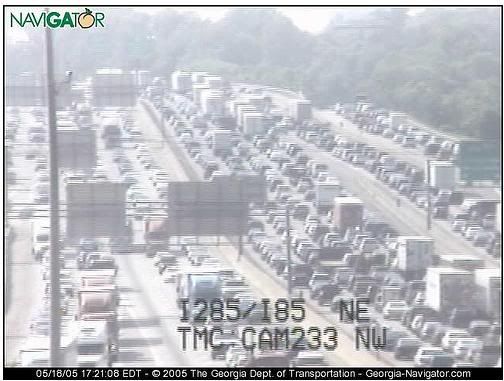
Monday, December 15, 2008
A good outline for that letter you're going to send to Congress
via Streetsblog:
To find out who your elected officials are, visit Congress.org.
Here's a template op-ed on the Transportation for America coalition's concerns about the shaping of the stimulus bill. This is a VERY critical moment in the debate. We think Congress should:
Conduct the discussions about what gets funded in the open: All states should make public what they are proposing. They should get no blank checks, but should be accountable toward national priorities. Those national priorities should include longterm benefits to the economy, safety, reduced oil dependence and carbon emissions. We should fix what we have before we build new highways.
Obama, Congress Must Back Up Rhetoric on Recovery
Last week President-elect Barack Obama made a promise to the American people and issued a charge to his incoming Administration and the next Congress:
"We won't just throw money at the problem. We'll measure progress by the reforms we make and the results we achieve – by the jobs we create, by the energy we save, by whether America is more competitive in the world." Dec. 6 Radio Address
As to how to achieve this progress, the President-elect proposed to “create millions of jobs by making the single largest new investment in our national infrastructure since the creation of the federal highway system in the 1950s.”
While the new President is clearly eager to chart a bold and new course to rebuild our economy from day one — and the new Democratic-controlled Congress should be poised to follow his lead — rhetoric alone will not be enough.
Members of Congress are already hard at work writing the stimulus package, reviewing transportation projects and infrastructure requests from states. Disturbingly, though, this is being done behind closed doors, and only a handful of states have made their wish lists public. Those that have are less than encouraging, focusing overwhelmingly on repaving, or worse, expanding highways in an era when people are driving less and transit is seeing surging demand.
Missouri DOT’s wish list, one of the few made public, includes an eye-popping $800 million worth of projects, 95 percent highway projects. This has next to nothing for St. Louis or Kansas City, population centers that surely need more than just highways. Arizona DOT’s list isn’t much better, with less than ten percent of money going to public transportation.
Congress is proposing to distribute stimulus money for infrastructure projects without requiring the usual local match, meaning that federal taxpayers will pick up the full tab. Given that reality, Congress must require transportation agencies to select projects that meet national goals for the future, rather than merely build yesterday’s highway projects.
If American tax dollars are spent the right way, we should get a three-for-one-return on our investment: a revitalized economy well positioned for long-term prosperity; less dependence on oil; and a reduction in climate-damaging emissions.
This is possible if the economic stimulus package the President-elect is expected to sign on day one includes a $100 billion investment to:
· Repair and preserve highways, bridges and existing public transportation service, and support the green jobs associated with this work;
· Build modern rail and rapid bus lines and upgrade all forms of service in cities large and small;
· Develop high-speed and other forms of inter-city rail; and
· Make streets safe for walking and biking.
Such investment will not only move America closer to fulfilling Obama’s vision for a bold, green recovery that will create jobs, reduce our oil consumption, and help America compete and thrive. It also will provide a down payment on a 21st Century transportation mission to build the second half of America’s transportation network, completing the system that began with the national highway system.
While repairing existing roads and bridges is a necessary expenditure, given that the national highway system has been built, federal resources and attention must go toward supporting the cleanest forms of transportation — public transit, high speed rail, walking and biking. The Transportation for America Campaign has identified more than 65 such ready-to-go projects within the next year, requiring over $17B in funding to get going.
Given that the stimulus is meant to fund only ready-to-go projects, states, transit agencies and metropolitan areas should quickly turn around a specific list of which projects will be funded, in an accessible and transparent manner. Tracking systems should also be instituted to provide the public with indicators on the number of jobs created, cost-effectiveness, carbon emissions, fuel use and demand forecasting.
U.S. Senator Harry Reid said earlier this month that the stimulus can allow us to “abandon the baby steps and embrace some great leaps forward” on energy, and House Speaker Nancy Pelosi added that the recovery is “about innovation and about the future, about building the jobs of the 21st century.”
That change is possible, but only if we put action behind rhetoric. And if we fail, Americans will not see the change the next Congress and Administration were elected on; rather, they will see more of the same.
David Goldberg
Communications Director
Transportation for America
office/mobile (202) 412-7930
www.T4America.org
To find out who your elected officials are, visit Congress.org.
Sunday, December 14, 2008
The bailout: Athens area projects announced
The Athens-Clarke County government has unveiled its list of "ready to go" projects, should Congress pass Barack Obama's proposed bailout plan for national infrastructure:
Athens-Clarke County Manager Alan Reddish said, "This would provide the types of jobs and infrastructure we need in this community and this country."
Reddish gave the mayors' group a list of 14 projects that are already on the county's books but, in many cases, lack funding. They would cost a total of $23.5 million and create 307 jobs, mostly in construction, he said. The projects include:I'm definitely happy to hear that Athens Transit will benefit from these funds if the bailout bill passes, but how long will the funds carry "more frequent" service? Will Athens enjoy a spike in bus availability, only to revert to the current level of service when the bailout funds run dry?"Those are projects we think are ready to go within 90 days," Reddish said.
- Adding a turn lane to Mitchell Bridge Road and reconfiguring its intersection with Athens West Parkway
- Fixing the Barnett Shoals Road-Old Lexington Road intersection
- More frequent Athens Transit bus service
For the first two projects above, how will the intersection be reconfigured and what will be fixed exactly? Will either project incorporate accessibility and safety for transit users, cyclists and pedestrians? Hopefully, more detail will emerge on these projects.
Friday, December 12, 2008
Deep decline in driving
I'm a sucker for alliteration.
AJC relays:
Let's see if she takes her personal realization and packs that "ready to go" list of state transportation projects with desperately needed mass transit infrastructure (bike paths and sidewalks would be nice stocking stuffers as well).
AJC relays:
Gas prices encouraged the GDOT Commissioner to switch from a Hummer to public transit. No baby steps for Gena Evans!It may not feel like it, but the American road is a lot more open these days.
In a year of historic changes in how we live, the federal government today is expected to announce yet another blockbuster. From November 2007 to October 2008, the U.S. saw the biggest sustained decline in miles driven in recorded history, according to the Federal Highway Administration.
Never before have Americans put the brakes on automotive travel in such a decisive way. Month after month, for an entire year, drivers put fewer miles on the road than they had the year before. It was an unprecedented stretch of highway-driving decline, according to FHWA spokesman Doug Hecox. The agency has been keeping records since 1942.
Vehicles on U.S. roads clocked 100.6 billion fewer miles in the year ending in October than they had traveled the year before, according to a monthly federal report expected today.
Georgians were among those helping drive the trend. Every month, they drove less than they did in that month the previous year. In August —- traditionally a big month for vacations —- Georgians chose to stay off the road by the biggest margin of the year.
In contrast, buses, trains and HOV registries are packed.
State Department of Transportation Commissioner Gena Evans is one of those people who cut down on driving.
After she and her new husband, former state Transportation Board Chairman Mike Evans, saw the rising cost to fill up his Hummer, she started riding mass transit to work in downtown Atlanta much of the time.
Let's see if she takes her personal realization and packs that "ready to go" list of state transportation projects with desperately needed mass transit infrastructure (bike paths and sidewalks would be nice stocking stuffers as well).
Thursday, December 11, 2008
An open letter to our state legislators
I just sent the following to two of Athens' legislators. I encourage you all to contact them as well. You can find your specific legislators' information here.
Dear Senator Cowsert & Representative Heard,If you do decide to write, be sure to include your full name and address so they know you're a bona fide constituent.
According to a recent AJC article, Governor Perdue said that "if the federal government sends stimulus money, the state will have projects ready to go." Simultaneously, "Georgia Transportation Commissioner Gena Evans said that the state could have $1 billion worth of projects ready to go in 180 days."
As a state employee, I am keenly aware of the budget woes we face. I am excited about the potential for postive, forward-thinking investment and job creation that this federal assistance could provide.
Our roads and bridges certainly need to be upgraded for public safety, but I am hopeful that a significant portion of this $1 billion will address our state's lagging and inadequate public transit, bicycle, and pedestrian infrastructure.
Governor Perdue has affirmed his commitment to improving Georgia's public transit, as have both of you. I hope the "ready to go" projects list incorporates mass transit projects, which can include design and construction for commuter trains and train stations, as well as the purchase and maintenance of trolleys and buses. Many citizens have already worked tirelessly to implement the long-overdue "Brain Train" from Athens to Atlanta. Federal funds could make convenient rail travel in Georgia a reality.
Likewise, our state needs to reevaluate its commitment to car-based development and car-centric road design. Family-friendly, sustainable communities include safe, networked, and accessible bicycle and pedestrian options. Increased walking and cycling opportunities will reduce traffic, improve air quality, and increase general physical activity, which, in the long run, will reduce the burden on our state's health care providers.
Cities and towns that are walkable and bikeable are widely considered to possess a high quality of life, making those communities desirable destinations for tourists and high tech industries alike.
In short, investing in public transit and other transportation choices will benefit our state in a number of important areas. Please make every effort to direct the General Assembly, the Governor and GDOT to invest in this infrastructure.
Wednesday, December 10, 2008
Stimulus bill details slowly emerge
The AJC reports on announcements made by Gov. Perdue:
Gov. Sonny Perdue told state lawmakers Tuesday that he will propose an “aggressive” package of borrowing to build schools, libraries, roads and other facilities to help stimulate Georgia’s struggling economy.President-elect Barack Obama has already said he wants Congress to pass a stimulus package to help pay for infrastructure improvements across the country.
Perdue said he’s not preparing his budget plan —- which will be released in mid-January —- with the idea of getting extra federal funding. However, if the federal government sends stimulus money, Perdue said, the state will have projects ready to go.
The American Association of State Highway and Transportation Officials reported in October that 3,100 projects totalling more than $18 billion could begin within 90 days with federal funding, and listed Georgia as having $397 million of those projects. Georgia Transportation Commissioner Gena Evans said that the state could have $1 billion worth of projects ready to go in 180 days, as long as the federal government could waive some regulatory requirements and spare the state from coming up with matching funds.
Perdue will make his proposal to lawmakers when they convene for the 2009 session Jan. 12. The House and Senate will then likely add projects to the package.
Before January 12th, tell your state reps & senators to fund more than highway expansion and interstate construction!
Tuesday, December 9, 2008
About that public works plan
Shocker! David Brooks, notable NYT supporter of bad ideas, argues for investing that massive public works money in transit and a post-suburban living arrangement:
Barack Obama has said that he would start an infrastructure project that will dwarf Dwight Eisenhower’s highway program. If, indeed, we are going to have a once-in-a-half-century infrastructure investment, it would be great if the program would build on today’s emerging patterns.
To take advantage of the growing desire for community, the Obama plan would have to do two things. First, it would have to create new transportation patterns. The old metro design was based on a hub-and-spoke system — a series of highways that converged on an urban core. But in an age of multiple downtown nodes and complicated travel routes, it’s better to have a complex web of roads and rail systems.
Second, the Obama stimulus plan could help localities create suburban town squares. Many communities are trying to build focal points.
Because we’re going to be spending $1 trillion now on existing structures and fading industries, there will be less or nothing in 2010 or 2011 for innovative transport systems, innovative social programs or anything else.
Before the recession hit, we were enjoying a period of urban and suburban innovation. We could have been on the verge of a transportation revolution. It looks as if the Obama infrastructure plan may freeze that change, not fuel it.
Monday, November 17, 2008
Bailing out transit killers
Harvey Wasserman summarizes the gruesome history of how GM put the kibosh on mass transit development.
Excerpt:
Excerpt:
GM responded to the 1970s gas crisis by handing over the American market to energy-efficient Toyota and Honda.GM met the rise of the hybrids with "light trucks."
GM built a small electric car, leased a pilot fleet to consumers who loved it, and then forcibly confiscated and trashed them all.
GM now wants to market a $40,000 electric Volt that looks like a cross between a Hummer and a Cadillac and will do nothing to meet the Solartopian needs of a green-powered Earth.
For this alone, GM's managers should never be allowed to make another car, let alone take our tax money to stay in business.
But there is also a trillion-dollar skeleton in GM's closet.
This is the company that murdered our mass transit system.
Subscribe to:
Posts (Atom)


 Posts
Posts


