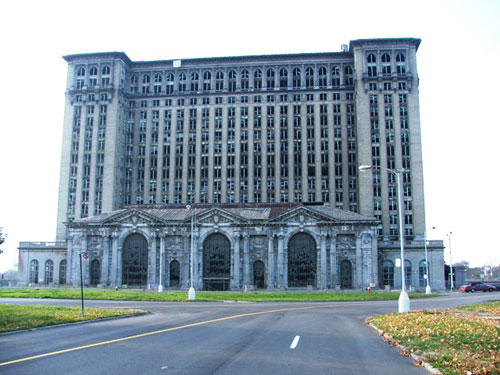
Detroit, the very symbol of American industrial might for most of the 20th century, is drawing up a radical renewal plan that calls for turning large swaths of this now-blighted, rusted-out city back into the fields and farmland that existed before the automobile.
Operating on a scale never before attempted in this country, the city would demolish houses in some of the most desolate sections of Detroit and move residents into stronger neighborhoods. Roughly a quarter of the 139-square-mile city could go from urban to semi-rural.
Showing posts with label culture. Show all posts
Showing posts with label culture. Show all posts
Saturday, March 20, 2010
Lost city of Atlanta?
Here's a thought provoking preview of what may be the end game to the sprawl-dependent economic model so prevalent in the southeast:


Wednesday, October 21, 2009
Tuesday, August 18, 2009
Decent bike parking
Slate.com's Tom Vanderbilt asks, "What would get Americans biking to work?"
His answer: decent bike parking
His answer: decent bike parking
Surveys have shown that the leading deterrent to potential bicycle commuters is lack of a safe, secure parking spot.Much more in the full article. Thanks to Mike E. for sharing this article.A number of American cities are now waking up to the fact that providing bicycle parking makes sense. Philadelphia, for example, recently amended its zoning requirements to mandate that certain new developments provide bicycle parking; Pittsburgh's planning department is weighing requiring one bicycle parking space for every 20,000 feet of development (admittedly modest compared with the not-uncommon car equation of one parking space per 250 square feet); even the car-centric enclave of Orange County, Calif., is getting in on the act, with Santa Ana's City Council unanimously passing a bill requiring proportional bicycle parking when car parking is provided. In Chicago, Los Angeles, and other cities, pilot projects are investigating turning car-parking meters—once semireliable bike-parking spots, now rendered obsolete by "smart meter" payment systems—into bike parking infrastructure.
Few cities are doing more than Portland—which has been experiencing a particular boom in bicycle commuting—to increase bicycle parking. In September, for example, the City Council will vote on code changes that would require residential buildings to have the same bicycle parking requirements as commercial buildings. Granted, Portland, Ore., is an unusual place for the United States: a place where business owners actually petition the city to build "bike corrals," or collections of racks that tend to swap one or two car parking spaces for a dozen bike spaces, in front of their establishments, and where residents casually drop lingo like staple, meaning the type of bicycle parking structure that looks like a staple stuck into the concrete. And in a move that is sure to give John McCain fits, the city is spending $1 million of federal stimulus funds on bicycle parking at transit hubs.
Monday, March 16, 2009
Monday, February 9, 2009
"the scale of our activities"
From his blog post today, James Kunstler:
What we really face is a comprehensive contraction in our activities, especially the scale of our activities, and the pressing need to readjust the systems of everyday life to a level of decreased complexity.
For instance, the myth that we can become "energy independent and yet remain car-dependent is absurd. In terms of liquid fuels, we're simply trapped. We import two-thirds of the oil we use and there is absolutely no chance that drill-drill-drilling (or any other scheme) will change that. The public and our leaders can not face the reality of this. The great wish for "alternative" liquid fuels (bio fuels, algae excreta) will never be anything more than a wish at the scales required, and the parallel wish to keep all our cars running by other means -- hydrogen fuel cells, electric motors -- is equally idle and foolish. We cannot face the mandate of reality, which is to do everything possible to make our living places walkable, and connect them with public transit. The stimulus bills in congress clearly illustrate our failure to understand the situation.
Thursday, January 15, 2009
"The Bicycle Diaries" on BBC radio
If you are able to listen to BBC radio, watch out for the upcoming Bicycle Diaries series:
UPDATE: BBC is live online & available in Athens via XM Satellite Radio and SIRIUS satellite radio.
According to the BBC website, this show will air Fri 9:06 am with repeats at 11:06 am , 8:06 pm, and Sat 1:06 am, 4:06 am, and Sunday 7:06 pm.
With more than a billion models around the world, the bicycle has found a place in every society. Since its invention in 1817 people have redesigned and used the bike for hundreds of different purposes, from sporting events and policing the streets to sharpening knives and selling ice cream. This three part series illustrates how the bike is used today and what impact it has on people’s lives.
UPDATE: BBC is live online & available in Athens via XM Satellite Radio and SIRIUS satellite radio.
According to the BBC website, this show will air Fri 9:06 am with repeats at 11:06 am , 8:06 pm, and Sat 1:06 am, 4:06 am, and Sunday 7:06 pm.
Wednesday, December 17, 2008
Saturday, December 6, 2008
Cautious optimism about "public works"
I hope Sonny and the state gang don't take this initiative for "the largest public works building program since the creation of the interstate highway system" to run hog wild with road widenings, interstate expansion, and other car-centric projects.
Invest that money in necessary safety projects, such as upgrading bridges, but use as much as possible on expanding Georgia's rail, transit, pedestrian, and bicycle infrastructure.
Per the article below, we might be in a calm-before-the-storm moment with gas prices, so we should proceed thoughtfully, especially since this might be our last shot at pouring national capital into something worthwhile.
Invest that money in necessary safety projects, such as upgrading bridges, but use as much as possible on expanding Georgia's rail, transit, pedestrian, and bicycle infrastructure.
Per the article below, we might be in a calm-before-the-storm moment with gas prices, so we should proceed thoughtfully, especially since this might be our last shot at pouring national capital into something worthwhile.
Friday, December 5, 2008
Downsides to cheap gas
Current gas prices are welcome relief from last summer's rapid spikes, but could the return to $2 gallons signal grim times ahead?
This story from Reuters points in that direction.
Excerpts:
This story from Reuters points in that direction.
Excerpts:
Motorists must be glad the price of fuel is one thing they do not have to worry too much about as they face the worst recession since the 1930s, but cheap fuel is not good for anyone in the long run.Global oil prices have collapsed since July, losing two thirds of their value from a peak of almost $150 a barrel and dragging fuel costs to their lowest levels for several years.
But while low energy costs come as welcome short-term relief to consumers and companies struggling with the financial and economic crisis, longer term they can be bad for everyone.
Low energy prices squeeze investment in the oil industry, reducing future supplies. They discourage energy saving and they destabilize countries dependent on oil exports, making oil in the future more likely to be expensive and even more volatile.
Perhaps most important of all, low energy prices stifle investment in alternative energy, deepening dependence on oil and other hydrocarbons and increasing greenhouse gas emissions.
...
"In the longer term, today's oil price is too low to support much new supply and will slow the momentum toward alternative fuels, new technology and conservation."
Thursday, December 4, 2008
The southern auto industry
A piece from the Christian Science Monitor discusses the rise of non-union auto manufacturing plants in the south, including a Kia plant in West Point, Georgia*.
Excerpts:
* I find it interesting that while West Point, GA is building a Kia plant, the Athens Kia dealership closed recently.
Excerpts:
The US auto industry is throwing bolts, but here in Georgia's Chattahoochee Valley a South Korean car company is building a massive new manufacturing plant along the new Kia Parkway, replacing abandoned textile mills.
...
The expansion of this "other" auto industry – one that's foreign-owned, nonunion, and based largely in the South – stands in stark contrast to this week's dire reports from America's own Big Three, whose CEOs laid out plans for a dramatic downsizing before traveling to Washington to plead for $34 billion in federal aid....
A prevalent right-to-work philosophy isn't the only reason foreign companies like Toyota have located plants in the South. There's also the proximity to a car-loving region with little mass transit and a population that totals that of the Midwest and New England combined.
* I find it interesting that while West Point, GA is building a Kia plant, the Athens Kia dealership closed recently.
Wednesday, November 26, 2008
No economic downturn for bicycle manufacturers
Today's AJC (print edition) has an opinion piece on the resilience of bicycle manufacturers in the face of widespread recession.
Excerpts:
Excerpts:
Interestingly, one of the world industries seemingly not suffering in the current worldwide recession... is the bicycling business.Top bicycle and bicycle parts makers in Taiwan and Japan are reporting steadily increasing revenues, despite the falling popularity around the world of the bicycle’s four-wheeled cousin.
And while I’m not quite sure that the data support any rush to judgment that commuters are peddling to work in greater numbers, we can at least feel confident that consumer spending on this basic commodity is steady.
...
Bicycles, then, seem to share an exalted status, along with certain foodstuffs, pharmaceuticals and precious few others, as recession-proof commodities that investors can count as farsighted (read lucky) picks.
Thursday, November 20, 2008
Transportation choices
I was looking through my pictures and found this one from a 2007 trip to Spain. This is a street in Sevilla, which was also in the midst of constructing a new subway system.
If you ever wondered what we mean by "transportation choices," this is it:

Multimodality from left to right:
1) a road (with as many buses as cars),
2) 2-way bike lanes, separated from motor vehicle traffic by a fence and a painted buffer, and
3) a wide sidewalk, separated from motor vehicle traffic by bike lanes and from bike traffic by a wide, tree-lined area. Crosswalks clearly marked.
This is how you do it.
If you ever wondered what we mean by "transportation choices," this is it:
Multimodality from left to right:
1) a road (with as many buses as cars),
2) 2-way bike lanes, separated from motor vehicle traffic by a fence and a painted buffer, and
3) a wide sidewalk, separated from motor vehicle traffic by bike lanes and from bike traffic by a wide, tree-lined area. Crosswalks clearly marked.
This is how you do it.
Wednesday, November 19, 2008
Chainless bikes
CNN reports on the growing use of chainless bike engineering.
Excerpts:
Excerpts:
Trek Bicycle is part of a movement to bury the finger-pinching, pants-munching, rust-prone sprocket and chain, and usher in an era of belt-driven bikes that might have the inventors of the self-propelled transportation Schwinning in their graves.
...
The largest U.S. domestic bike manufacturer is hoping to capitalize on a new group of urban pedal-pushers who are trading their cars for a more low-tech way to get around because of gas prices as well as health and environmental concerns.
...Aside from the whisper-quiet ride, the lighter and longer-lasting carbon-fiber composite belts won't rust, can't be cut, won't stretch or slip and won't leave grease marks around your ankles. A guard over the belt-drive and the construction of the system makes getting your pants stuck an unlikely scenario.
One version of the chainless bike, called the District ($930), is a single-speed, complete with a silver body, orange accents and brown leather seat and handles. The other, called the Soho ($990), is an eight-speed bike that uses an internal hub to adjust the speed rather than gears.
Monday, November 3, 2008
Thursday, October 16, 2008
James Kunstler speaking at UGA on 10/21
Renowned author and commentator James Howard Kunstler will be speaking at UGA next week.
Kunstler was the keynote speaker at our inaugural Tour de Sprawl event in 2000.
Event details and flyer below:
James Howard Kunstler
Tuesday, 10/21, 4 pm
The Chapel on UGA's north campus
FREE!

Kunstler was the keynote speaker at our inaugural Tour de Sprawl event in 2000.
Event details and flyer below:
James Howard Kunstler
Tuesday, 10/21, 4 pm
The Chapel on UGA's north campus
FREE!

Thursday, July 10, 2008
Suffering suburbs
This article from the US Daily describes the nationwide trend pushing people away from car-based suburbia and toward walkable, bike-friendly, and transit-oriented developments.
Excerpts:
Excerpts:
The iconic white picket fence [of suburbia] comes with a hefty price tag in the form of the cost of the gasoline needed to drive to work and to the supermarket, and the suburban idyll is under review.
...Tracy McKelvey and his wife Jan lived in a ... suburb and used to commute two hours each day to their jobs in Phoenix. But, a few years ago, they traded in their three-bedroom, two-garage house in the Phoenix valley for a downtown loft.
Both McKelveys now travel to work by scooter and enjoy restaurants, cafes, sports arenas and shops within walking distance of home, taking advantage of the $2.3 billion that the country's fifth-largest city is spending to build housing, a university campus and a mass transit rail system.
"We save money on gas. It's a good feeling. I haven't sat in a traffic jam for years," Tracy McKelvey said.
...
"These are not the cyclical changes that recessions cause every few years. These are game-changing structural changes," [University of Michigan real estate development professor Christopher] Leinberger said. "The market is demanding walkable urban product."
Thursday, July 3, 2008
The dinosaur days
Part II in a long Telegraph series on America & China discusses Detroit, cars, suburbia, and these "dinosaur days" of all three.
Excerpts:
Excerpts:
Full story here.Mass production...soon moved from [Detroit] to all places of American industry 'and set the pattern of abundance for 20th-century living'.
It is a wonderfully evocative phrase that stops you in your tracks - the pattern of abundance for 20th-century living. From here came the principles of mass production that provided the goods that fuelled the consumer society; from here, the automobile that begat the roads and the freeways that carried people and goods from sea - as America the Beautiful has it - to shining sea, and then to the world beyond.
...Driving around Detroit one was forcefully struck by how the city had been irrevocably shaped - and continued to be shaped - by the car.
Detroit has the second largest amount of freeway lane miles of any metropolitan area in America, after Kansas City. And it is the only city in America without a rapid transport system - the legacy of years of resistance by the powerful lobby of the car industry that dictated that workers should drive their own products rather than taking public transport.
One of the city's most astonishing architectural relics is the Michigan Central Station, a towering, beaux-arts structure built in 1913. The last train pulled out in 1988. But like many of Detroit's great ruins it had proved too expensive to renovate, too expensive to demolish, and so had been left to stand, an enduring testament to the city's decline, and a reproof to its plans for regeneration.
...
Ford's greatest legacy was the car and all that grew from it. As Christopher Leinberger, a professor of urban planning at the University of Michigan, points out, the nature of the American dream has always been driven by the underlying economy of the age. In 1800, at the time of the first census, more than 90 per cent of Americans were engaged in agriculture. 'The American dream at that point could be summarised by the Civil War expression "40 acres and a mule". In the post-war era, one-third of the American economy was related directly, or indirectly, to the building of automobiles - steel, cars, roads, petroleum, insurance. There was an expression that GM used "See the USA in your Chevrolet" - so as you travelled the roads of America in your car you were making yourself and the country wealthier'.
The car become synonymous with America's most cherished ideal - freedom: the freedom to go, to move, to be wherever you chose.
Tuesday, May 27, 2008
Kunstler: wishing vs doing
James Howard Kunstler has an editorial in the Washington Post that neatly summarizes the dangers of our addiction to (rapidly disappearing) oil. Excepts below:
The public, and especially the mainstream media, misunderstands the "peak oil" story. It's not about running out of oil. It's about the instabilities that will shake the complex systems of daily life as soon as the global demand for oil exceeds the global supply. These systems can be listed concisely:
The way we produce food
The way we conduct commerce and trade
The way we travel
The way we occupy the land
The way we acquire and spend capital
And there are others: governance, health care, education and more.
As the world passes the all-time oil production high and watches as the price of a barrel of oil busts another record, as it did last week, these systems will run into trouble. Instability in one sector will bleed into another. Shocks to the oil markets will hurt trucking, which will slow commerce and food distribution, manufacturing and the tourist industry in a chain of cascading effects. Problems in finance will squeeze any enterprise that requires capital, including oil exploration and production, as well as government spending. These systems are all interrelated. They all face a crisis. What's more, the stress induced by the failure of these systems will only increase the wishful thinking across our nation.
...
So what are intelligent responses to our predicament? First, we'll have to dramatically reorganize the everyday activities of American life. We'll have to grow our food closer to home, in a manner that will require more human attention. In fact, agriculture needs to return to the center of economic life. We'll have to restore local economic networks -- the very networks that the big-box stores systematically destroyed -- made of fine-grained layers of wholesalers, middlemen and retailers.
...
Fixing the U.S. passenger railroad system is probably the one project we could undertake right away that would have the greatest impact on the country's oil consumption. The fact that we're not talking about it -- especially in the presidential campaign -- shows how confused we are. The airline industry is disintegrating under the enormous pressure of fuel costs. Airlines cannot fire any more employees and have already offloaded their pension obligations and outsourced their repairs. At least five small airlines have filed for bankruptcy protection in the past two months. If we don't get the passenger trains running again, Americans will be going nowhere five years from now.
...
We cannot afford to remain befuddled and demoralized. But we must understand that hope is not something applied externally. Real hope resides within us. We generate it -- by proving that we are competent, earnest individuals who can discern between wishing and doing, who don't figure on getting something for nothing and who can be honest about the way the universe really works.
Friday, May 23, 2008
Bikes helping liberate women
Here's an interesting post from Salon.com:
Wheels of change
A bicycle is a perfect machine: simple, elegant and efficient. It does exactly what it needs to do, whenever it needs to do it (unless, of course, its chain falls off in the middle of the pouring rain on a bridge, but that's a story for another time). But beyond providing environmentally friendly transportation, exercise and a heartening feeling of bohemian European-ness as one pedals along, there's a convincing case (laid out by none other than Susan B. Anthony herself!) that the bicycle advanced the cause of women's liberation more than any other inanimate object.
According to this Mental Floss article, in the 19th century, "the Victorian lady rarely exercised or engaged in physical activity, which left her poorly conditioned." But the appearance and popularity of the bicycle in the late 1800s changed all that. Unlike horses, which could be difficult to control (particularly when one was trammeled by the dangerously ladylike convention of riding sidesaddle), "bicycles, by comparison, were easy to manipulate. There was no reason a woman couldn't get on a bike and sedately pedal farther from her home than she'd ever been before."
I used to live in Holland, where bicycles are as much a part of the landscape as cars are in the States, and the sense of freedom when you are riding across a perfectly flat landscape with the wind at your back can be pretty exhilarating, physically and psychologically. But reading this, I can't help thinking, a little sadly, of the spinning classes I walk past every day at the gym -- 30 or 40 women, all in terrific shape, pedaling none too sedately … and going nowhere.
Monday, February 25, 2008
"Bicycle nomads, Texas utopianism, and the post-petroleum era"
An interesting piece from Orion magazine:
"Send in the Clowns: Bicycle nomads, Texas utopianism, and the post-petroleum era"Click the link above for the whole article.
Excerpt:
GIVEN THE UNSETTLING STATE OF THE WORLD, I’ve spent the last few years shopping around, as it were, for my own little handbasket to ride into hell. In New York City, at Critical Mass rallies and with radical bicycle gangs like Black Label, I’ve begun to discern the contours of a movement of mostly young people who believe that the American pursuit of happiness has taken a decidedly wrong turn somewhere on the interstate and gotten lost among the tract homes dotting the subdivisions of Eden. For the radical few, the bicycle is an important part of the solution. The bicycle, that technological throwback from the nineteenth century, is for them a literal and metaphorical organizing principle for a new vision of the world, one that stands not simply against the most obvious form of petro-consumption, the automobile, but that heralds and celebrates—in advance of its actual arrival, and with bright little bicycle bells and radical cheers—a new, post-petroleum era.
Subscribe to:
Posts (Atom)


 Posts
Posts